Breaking Through the Ceiling: The Three Growth Barriers Holding MSPs Back
There's a question Aaron Smith and I put in front of a room of MSP owners recently, and I want to start there. What happens to your business if you disappear for a month? Does it die? Does it limp? Does it quietly flourish? If the honest answer makes you uncomfortable — good. That discomfort is the starting point for everything we talked about. Because every MSP hits ceilings. Not once. Repeatedly. The shape changes, the names change, the numbers change — but the pattern is remarkably consistent. And in our combined decades of building, running, coaching and exiting MSPs, Aaron and I have seen three ceilings that come up again and again. Here's what they look like, and what it actually takes to break through them.
Nick Clift
7/2/20265 min read
Breaking Through the Ceiling: The Three Growth Barriers Holding MSPs Back
There's a question Aaron Smith and I put in front of a room of MSP owners recently, and I want to start there.
What happens to your business if you disappear for a month?
Does it die? Does it limp? Does it quietly flourish?
If the honest answer makes you uncomfortable — good. That discomfort is the starting point for everything we talked about.
Because every MSP hits ceilings. Not once. Repeatedly. The shape changes, the names change, the numbers change — but the pattern is remarkably consistent. And in our combined decades of building, running, coaching and exiting MSPs, Aaron and I have seen three ceilings that come up again and again.
Here's what they look like, and what it actually takes to break through them.
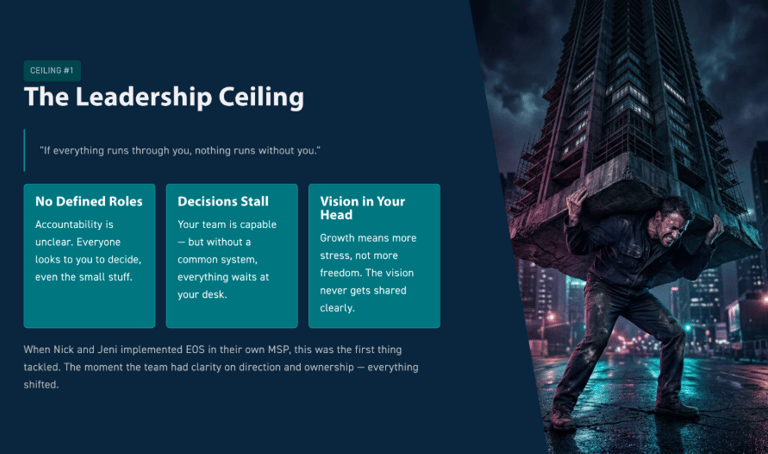
Ceiling One: The Leadership Ceiling
The first ceiling is almost always this one.
You started the business. You're the best technician in the room, probably the best salesperson too, and you've built something real on the back of that. But at some point, everything starts flowing through you.
Every decision. Every escalation. Every client relationship that actually matters.
You are the bottleneck — and the business can only grow as fast as you can personally handle.
I had this pointed out to me in fairly unambiguous terms by a business coach we'd brought in from the US. He sat the three of us down — me, my partner Jenny, and our third shareholder — and told us plainly that we were a love fest. Nobody was holding anybody accountable. The business was built around my ego, not around systems.
He wasn't trying to be kind. He was trying to be useful.
The outcome: I was removed as managing director. Jenny became general manager. I became the sales manager. And I sulked for about two years.
But it changed everything.
The realisation that took longest to land was this: even smart, capable people need to know what success looks like in your business. They're not going to intuit your standards, your client expectations, or how decisions get made. If you don't give them structure and clarity, they'll default to asking you. Every time.
That's not a people problem. That's a structural problem.
The leadership ceiling doesn't come down until you're genuinely willing to define accountability clearly — who owns what, who makes which decisions, and what the business expects from each seat. Not in your head. On paper. Shared with the team.
One rule we implement consistently: only one person can hold accountability for a given function. Not two. Not three. One. When that's clear, people stop coming to you. And your phone starts getting quieter. Which feels strange at first. Then it feels like freedom.
Ceiling Two: The Revenue Ceiling
The second ceiling tends to show up once the first one is being worked on.
Revenue plateaus. The referral engine — which has served you well for years — starts running dry. You've talked to everyone in your network. The Rolodex is exhausted. And the business hits a wall.
Here's what I've observed: most MSP owners are actually excellent at selling. They just don't identify as salespeople. They hold genuine expertise, they earn trust quickly, and when they're in front of the right person, they close. The problem isn't the selling. It's the consistency of the pipeline.
Two things tend to break the revenue ceiling.
First: look in your own backyard. Before chasing new logos, there is almost always revenue sitting untouched inside your existing client base. We connected a tool early on that scanned our client data — hardware out of warranty, expired licences, underserviced accounts — and came back with three and a half million dollars of opportunity. Inside clients we were already managing.
We'd been ignoring them. Not intentionally. We just hadn't asked the right questions.
"How's your business going? What are you trying to achieve this year? What's keeping you up at night?"
That's the entire strategy. Ask better questions of the people who already trust you.
Second: don't hire a BDM before you have an engine. This is a mistake I've seen made over and over — and made myself. You meet someone with great energy and good contacts, you bring them on, and for the first twelve months it goes well. Then their network dries up. They come to you and ask: where are my leads? And you don't have a good answer, because the lead generation system was always meant to be them.
The sales engine — the way leads enter your world, get nurtured, and move to conversation — needs to exist before a BDM can work effectively. You're your own BDM until that engine is running.
There's also a subtler problem worth naming: the sabotage cycle. You sell hard, the service team gets loaded up, backlog builds, and your brain quietly tells you to stop selling. You don't decide to stop. It just happens. Having a system that separates the sales engine from the capacity conversation is what breaks that pattern for good.
Ceiling Three: The Identity Ceiling
This one is the hardest. Not because the work is complicated — but because it requires something genuinely personal.
At some point, the business needs to be bigger than you.
Your clients need to trust your team, not just you. Your team needs to run things without your daily involvement. Your name can't be the answer to every question.
For a lot of MSP owners, this feels like a threat to identity. The business is who they are. It's what they built. The idea of it running without them doesn't feel like freedom — it feels like irrelevance.
I remember the exact feeling. I started ringing my own mobile from the office to check it was still working, because the calls had dried up. The team had it handled. Clients were calling them.
And my first response was: have I made myself redundant?
The honest answer was: yes. And that was the whole point.
You can't let your own insecurities hold your business back. That sentence is easy to read and genuinely hard to implement. But here's what I've found: the way through the identity ceiling isn't to detach from the business — it's to get clear on what comes next for you. The identity needs somewhere to go.
For me, it was the merger, the exit, and eventually — Bali, coaching, this conversation we're having right now.
Until I could picture that next chapter clearly, I kept holding on. Once I could, I was able to build the business in a way that genuinely didn't need me. And that's what made it sellable.
The Breakthrough Equation
Structure + Sales Engine + Scaling Beyond Yourself.
None of those three works without the others. You can build the best accountability structure in the world — but if revenue is stuck, you'll never fund the leadership team you need. You can hire a BDM and build a pipeline — but if every decision still comes back to you, growth stalls. You can step back from operations — but if you haven't replaced yourself with the right people in the right seats, the wheels come off.
These ceilings come down together. And they come down through honest conversation, consistent structure, and — occasionally — a good coach who isn't worried about your feelings.
If any of this resonates, I'd genuinely love to have a conversation.
Not a sales process. Just a chat.
Nick Clift is an MSP leadership coach and fractional operational partner at Tenassia Pty Ltd. He built and exited his own MSP in 2022 after 26 years, and now works with MSP owners across Australia and Southeast Asia. He co-hosts the MSP Mastery podcast. You can reach him at nick@tenassia.com.